

“Sometimes people are not resisting feedback. They are protecting themselves from embarrassment.”Reflection card · Episode note
The Growth Notes
Real situations.
Useful reflections.
Better ways forward.
Short reads and practical tools for the conversations, tensions and decisions that come with leading people and working together.
Start with whatever feels familiar.
Explore The Growth Notes
Choose what you need today.
Read for a fresh perspective. Pause with a short reflection. Or open a tool for a real situation.
Read
Articles
Longer reflections on the human moments that shape leadership and teamwork.
Article
The moment communication becomes unsafe
People rarely stop speaking honestly all at once. They stop one small moment at a time.
Communication · 7 min read→ ArticleLeadership pressure is often invisible
Some of the hardest parts of leadership happen after the meeting is already over.
Leadership · 7 min read→Pause
Short reflections
A thought worth carrying into the next conversation.
“Clear communication is not about perfect wording. It’s about reducing fear, confusion and assumptions.”Reflection card · Episode note
“Silence is not always agreement. Sometimes it is protection.”Reflection card · Communication
“Sometimes the most important leadership skill is not reacting immediately.”Reflection card · Leadership
Use
Tools & resources
Practical support for preparing, pausing, diagnosing and moving forward.
Difficult Conversation Prep SheetTen questions to help you prepare with more clarity, calm and care.Open tool +
Download PDF ↓ ">
Download PDF ↓
Some conversations become heavier the longer we carry them in our head. You do not need perfect words. You only need more clarity before the conversation begins.
Before the conversation
- What conversation am I avoiding?
Write down the conversation you keep postponing or replaying in your head. - Why does this conversation feel difficult?
What feels emotionally heavy, uncomfortable or uncertain? - What am I actually afraid might happen?
Conflict, disappointment, tension, being misunderstood or damaging the relationship? - What might the other person be experiencing right now?
What pressures, emotions or concerns could they be carrying? - What might the other person need from this conversation?
Clarity, honesty, reassurance, boundaries, feedback, support, accountability or understanding?
Clarity before communication
- What outcome do I actually want?
What would a healthier or more constructive outcome look like? - What would clear and calm communication look like here?
Think about tone, pace, wording, openness and emotional regulation. - What part of this conversation can I control?
And what part can I not control? - What would help me stay grounded?
Slowing down, listening fully, breathing before reacting or asking questions instead of assuming? - What is one thing I want to remember before the conversation begins?
Difficult conversations rarely become easier when we avoid them. They can become clearer, calmer and more human when we prepare differently.
Before You React ChecklistA tiny pause framework for the moment emotion arrives before clarity.Open tool +
Download PDF ↓ ">
Download PDF ↓
Leadership conversations often become more difficult when we react before we fully understand what is happening inside us.
Tiny Pause Framework
- What emotion is leading me right now?
- What assumptions am I making?
- What outcome do I actually want from this conversation?
Sometimes the healthiest leadership response begins with a pause, not an immediate reaction.
Situation DiagnosisDiagnose before you act: choose the right kind of management for this person, in this situation, now.Open tool +
tool-preview">
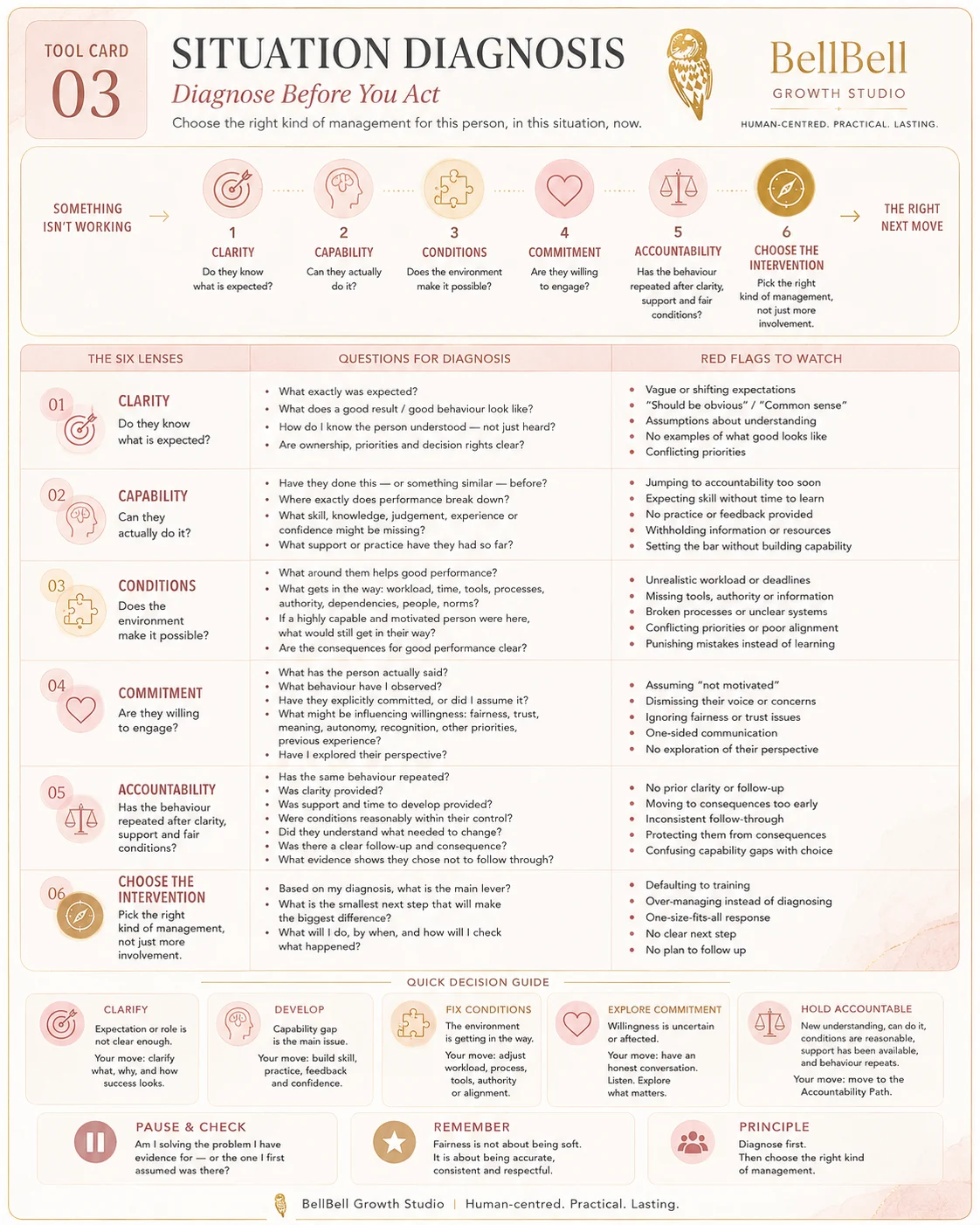
When something is not working, more involvement is not always the answer. Move through six lenses before choosing the intervention.
- 1. Clarity
Do they know what is expected? - 2. Capability
Can they actually do it? - 3. Conditions
Does the environment make it possible? - 4. Commitment
Are they willing to engage? - 5. Accountability
Has the behaviour repeated after clarity, support and fair conditions? - 6. Choose the intervention
Pick the right kind of management, not just more involvement.
BellBell question: Am I solving the problem I have evidence for — or the one I first assumed was there?
Accountability PathClear expectation, honest conversation, fair support and real follow-through.Open tool +
tool-preview">
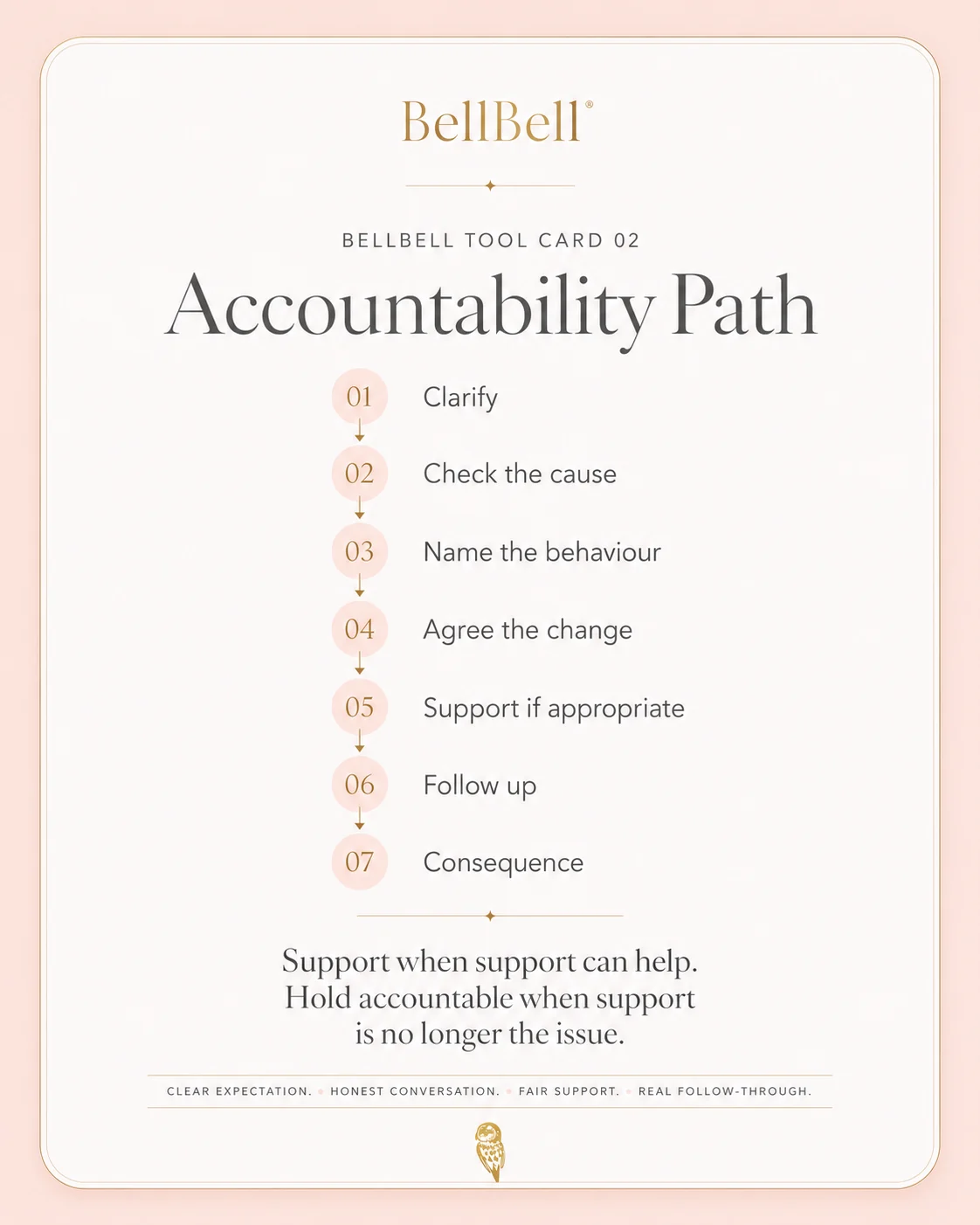
Support when support can help. Hold accountable when support is no longer the issue.
- Clarify
- Check the cause
- Name the behaviour
- Agree the change
- Support if appropriate
- Follow up
- Consequence
Principle: Accountability is not about being harsh. It is about being clear, fair, consistent and respectful.



A quiet next step
Something here feels familiar?
If you would like to think it through with someone, we can start with a conversation.
Book a discovery chat